
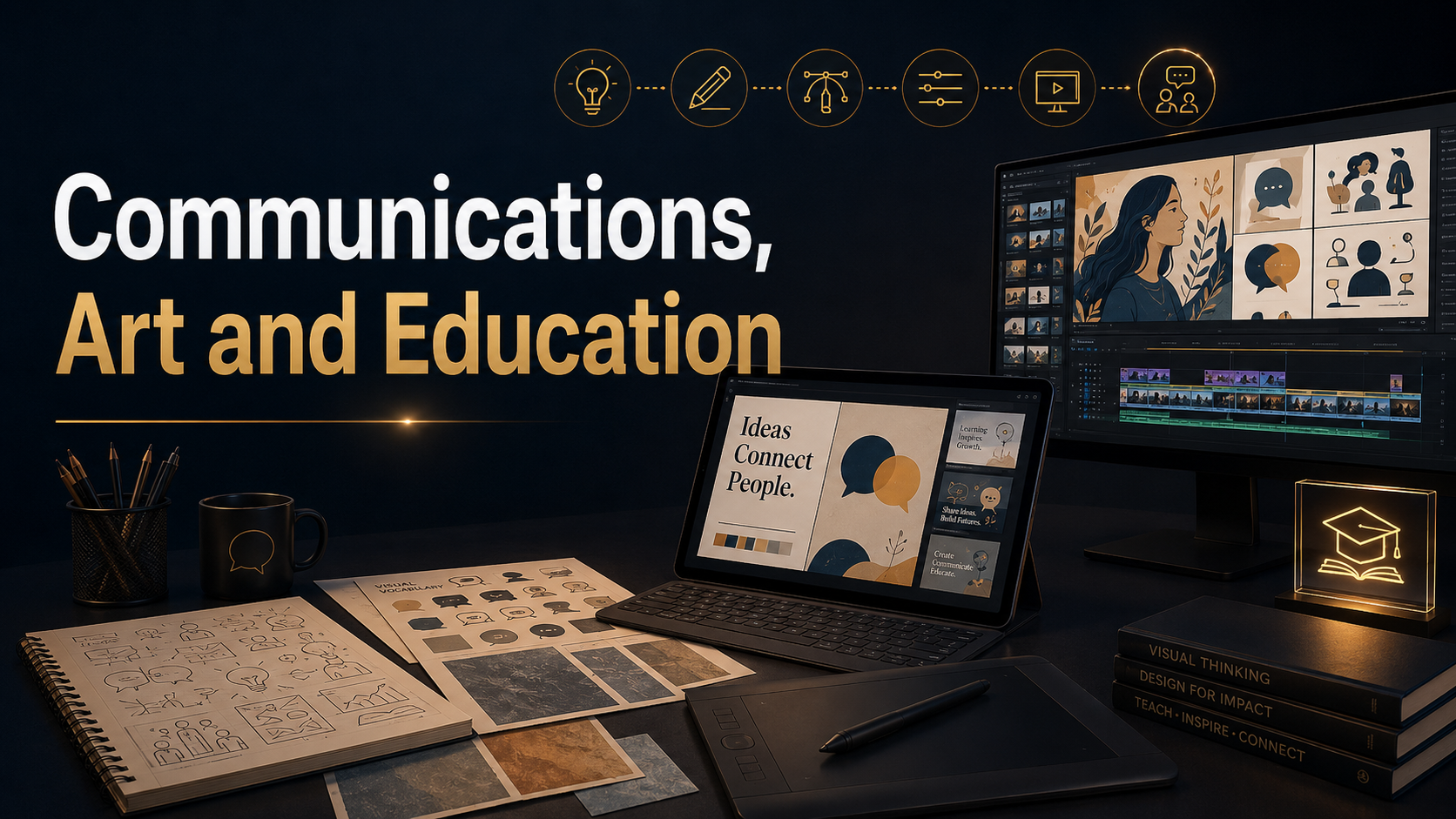
Communications, art, and education coursework helped me build a stronger visual vocabulary. This section explores how images, symbols, movement, texture, and design choices can be used to explain ideas, connect concepts, and communicate meaning across different forms of media.
The creative process in this section focused on experimentation and interpretation. I explored digital art as a way to relate visual concepts to larger ideas, including art movements, design styles, storytelling methods, and communication goals. Artificial intelligence image generation was used as a research and exploration tool to help define and compare art movements, visual styles, and creative approaches.
Adobe Photoshop was used to create seamless textures, icons, visual assets, and animation elements. These projects helped me understand how small design choices such as shape, repetition, contrast, pattern, and color can support a larger communication goal. Adobe Premiere Pro was used to create short video clips and motion-based pieces, adding timing, sequence, and movement to the visual communication process.
Adobe Express was also used to create CTA images and visual communication pieces using AI image generation. This added another layer to the process by combining layout, messaging, generated imagery, and design judgment into finished digital assets.
This section shows how visual communication can move beyond decoration. Each project helped me practice using images, design tools, and digital media to explain ideas with more clarity and intention. Use the links on this page to explore the projects and see how different creative tools were used to build visual meaning.
Explore my progress through these links
Other college coursework and projects
Visual Vocabulary Art and Design Movements
Visual vocabulary video and animation
College Portfolio projects
Photography
Advanced Image Editing
Digital Video
Directing & Production
Video Editing
Graphic Design
Web Design
Infographics & Data Visualization
3D Design
Digital Illustration
Digital Storytelling
Digital Portfolio
E-Book Design & Publishing
UI/UX User Interface & User Experience
Social Media Marketing
Integrated Study Honors

The Art of Adapting: Why Change Fuels Better Design
Design is always moving. New tools, audiences shift, and the ways we communicate change. The people who succeed are the ones who stay curious, experiment with intention, and treat change as a chance to grow.
In communications, adaptation is essential. The platforms we use are always reshaping how messages are shared and understood. Designers who embrace these shifts can create clearer and more meaningful stories that reach people where they already are.
In art, innovation has always pushed the field forward. From early pigments on stone to digital canvases and new creative technologies, artists expand what is possible by trying unfamiliar tools and techniques. Each step into the unknown opens new ways to express ideas and connect with others.
In education, learning to adapt is a core skill. Students who practice iteration, experimentation, and revision build the resilience needed for real problem solving. When classrooms welcome new tools and evolving design methods, they prepare learners to keep pace with the future and help shape it.
Success belongs to those who move with purpose, stay open to new ideas, and let innovation sharpen their craft. Design is alive, and its most exciting work comes from people who are willing to evolve with it.
If you want to see how these ideas show in my own work, explore the links in the sidebar to the left. My college portfolio is filled with projects shaped by curiosity, growth, and creative adaptation.